Can Rocketry At Last Herald ‘Science’ in Indian Cinema?
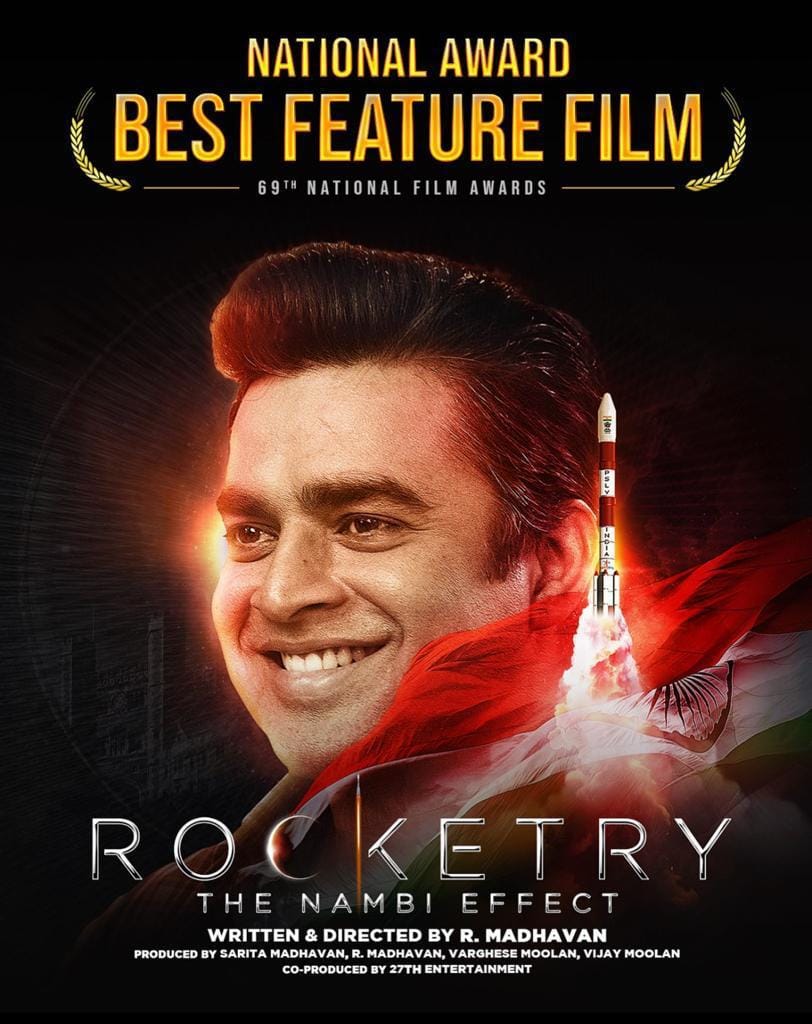
Indian cinema is notably underrepresented in the science fiction genre. Finding credible movies from this genre in a romance-infested Indian cinema is as arduous as finding a needle in a haystack. However, whenever an advertisement for a movie that comes close to this genre appears, it naturally rouses curiosity. One such upcoming movie is Rocketry: The Nambi Effect, based on Padma Vibhushan Nambi Narayanan's life.
India takes great pride in its commercial music, television, and cinema. It is the nation's most potent soft-power tool, and its potency is very well known to India's friends and foes. India is also a knowledge-venerating society and has always revered scholars and enterprising innovators. But then again, our pride in popular cinema and our reverence for scholars never blended. The trailer of the movie Rocketry had many surprises, with the most notable being the surprise cameos of Suriya and Shahrukh Khan. When did Indian cinema ever depict Vikram Sarabhai in a movie? This movie does. The last time Sarabhai's name cropped up was 17 years ago, in Ashutosh Gowariker's Swades, when the protagonist makes up his mind to leave NASA for ISRO's Vikram Sarabhai Space Centre. When did Indian cinema ever depict Vikram Sarabhai in a movie? The last time Sarabhai's name cropped up was 17 years ago, in Ashutosh Gowariker's Swades, when the protagonist makes up his mind to leave NASA for ISRO's Vikram Sarabhai Space Centre.
There were two other surprises in the trailer. In one scene, R. Madhavan, who plays Nambi Narayanan, is shown walking with his colleagues through a rocket-engine workshop wearing aprons of SEP. SEP stands for the Société Européenne de Propulsion, which today goes by the name of SAFRAN. This is the same SAFRAN that has made the engines of the Rafale fighter aircraft bought by India, after great anguish given by vested interests. The third surprise was in another snippet that showed a table- and standee flag of GLAVKOSMOS and a poster of the Soviet space shuttle Buran. These three props appear in the backdrop when Rocketry's protagonist exchanges handshakes with his Soviet counterpart. GLAVKOSMOS is the same Russian entity that agreed to provide the upper-stage cryogenic engine to ISRO, which was curtailed by the Clinton Administration and later put Nambiji in tremendous personal upheaval. Whereas the poster of Buran, which carried the logo, SCC. Few people are aware that SCC stands for Space Commerce Corporation, the first US-Soviet joint venture aimed at supplying Soviet space technology products to the West behind the Iron Curtain. For the uninitiated and uninformed, the snippet shows Nambiji's prowess and acumen in bypassing the corridors of geopolitical hyper-powers and making his mark for India's cause. There are also a few snippets where one might have come across a character playing formidable Satish Dhawan, the former chair of ISRO. We can also see another actor playing the people's President APJ Abdul Kalam's role, who tells Nambiji, "It's time for you to take us to the stars!" All these are evidence of a well-researched movie.
Since this is a biography, the viewers may see many scenes based on Nambiji's anecdotes and personal life, many taken with cinematic liberties. However, the movie has tamed the unwanted urge for such privileges, which often eats away at the harsh realities of life. But this article is not a trailer reaction review - but a review of the state of Indian science in popular Indian cinema. Do you know if it exists?
Indian popular cinema has rarely edutained and has been far away from science. There may be a lack of scientific acumen on the part of financiers, directors, and scriptwriters. Likewise, those pursuing Indian science have rarely spoken about the science in a way that excites the masses. As a young nation, many of our groundbreaking achievements in space, bioscience, chemistry, atomic physics, and defence remain classified or untapped. But once these caskets open, as time passes, we have a plethora of stories to tell in the history and biography genres. But what about soft- and hard-fiction? We all lament the absence of movies and documentaries like Interstellar, Inception, Tenet, Contact, Space Odyssey, or The Martian. Those who attempt similar genres in India tend to ape their inspirations because there is a lack of dialogue between the scientific and cinematic worlds. But who will create such a dialogue between the two worlds? The government? Certainly not. Indian cinema will suffer if it continues to serve valueless junk entertainment. Indian science may also suffer if it does not deduce intelligent ways to tell stories and inspire the next generations to take up science. If India wants to become an Aatmanirbhar Bharat, it will have to provide equal education and entertainment to the young ones. And for this great cause, able scientists and moviemakers should collaborate often.
Nambiji's life is exceptional, and it was asking to be nurtured into a story with care. So are the lives of Homi Bhabha, Vikram Sarabhai, and APJ Abdul Kalam. Indian cinema has long had a penchant for politicians, sportsters, actors, and especially frauds. The recent high they have reached is in making movies in a certain market bull. But have they ever cared to tell the story of the Bull - Col. Narendra Kumar? The great mountaineer, the champion of Operation Meghdoot, saved Siachen from China and Pakistan's clutches. Such stories won't be told until Indian cinema sheds its fascination with the Don cinematic universe and acknowledges its debt to the Don's finances and his siblings, friends, foes, and contemporaries in North and South.
The cinematic taste of modern Indians is evolving. Some people believe that our evolution is a form of aping the West. But that is not the case at all. We want to know more, more about individuals who have brought glory to Bharat for millennia. We want to know more about great events in our civilisation's chronicle. We want to learn more about our fiction, our epics, our successes, and our failures.
Modern Indians are well aware of the stale content they have been served in the name of cinema and the intentions behind its presentation. Modern Indians are now very well aware of cinema and cinema influencers being used as part of vile information, disinformation, and misinformation warfare by India's adversaries. With such a realisation, the old 'filmy' gimmicks and shenanigans, along with those performing them, are becoming obsolete.
Rocketry's trailer is quite promising, and due credit to Madhavan, who has directed and produced it. It does not seem to disrespect the protagonist and his pursuit's seriousness, with needless song and dance. Despite the absence of usual desi cinema cliches, the movie may attract footfall. If it fails to manage theatre viewership in the wake of the pandemic, it may as well become a cult classic. But on a larger canvas of time, the movie has all the makings of becoming a pioneer in the biographical genre of scientists, and to stretch expectations even into science and science fiction genres. If that happens, then the theory that has been peddling stale content to us Indians will fall on its face. However, these are not the expectations of one movie. These are the expectations of a middle-class, modern, and educated Indian from Indian Cinema.
The original piece was published in NewsBharati.


